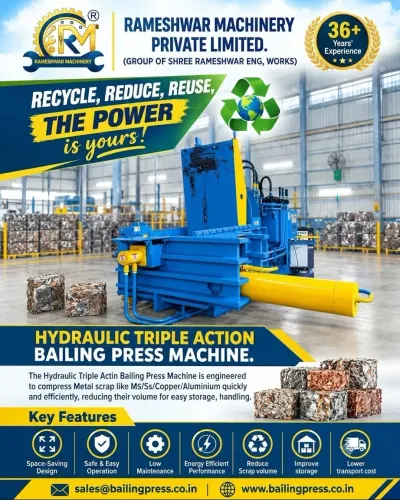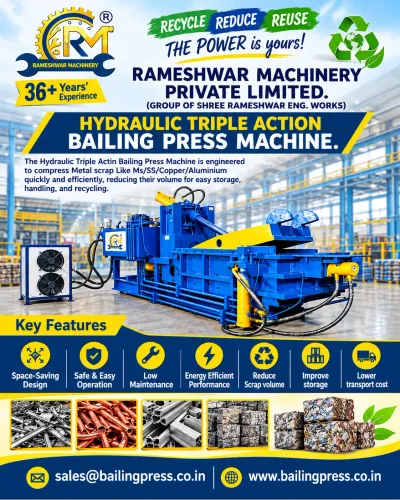
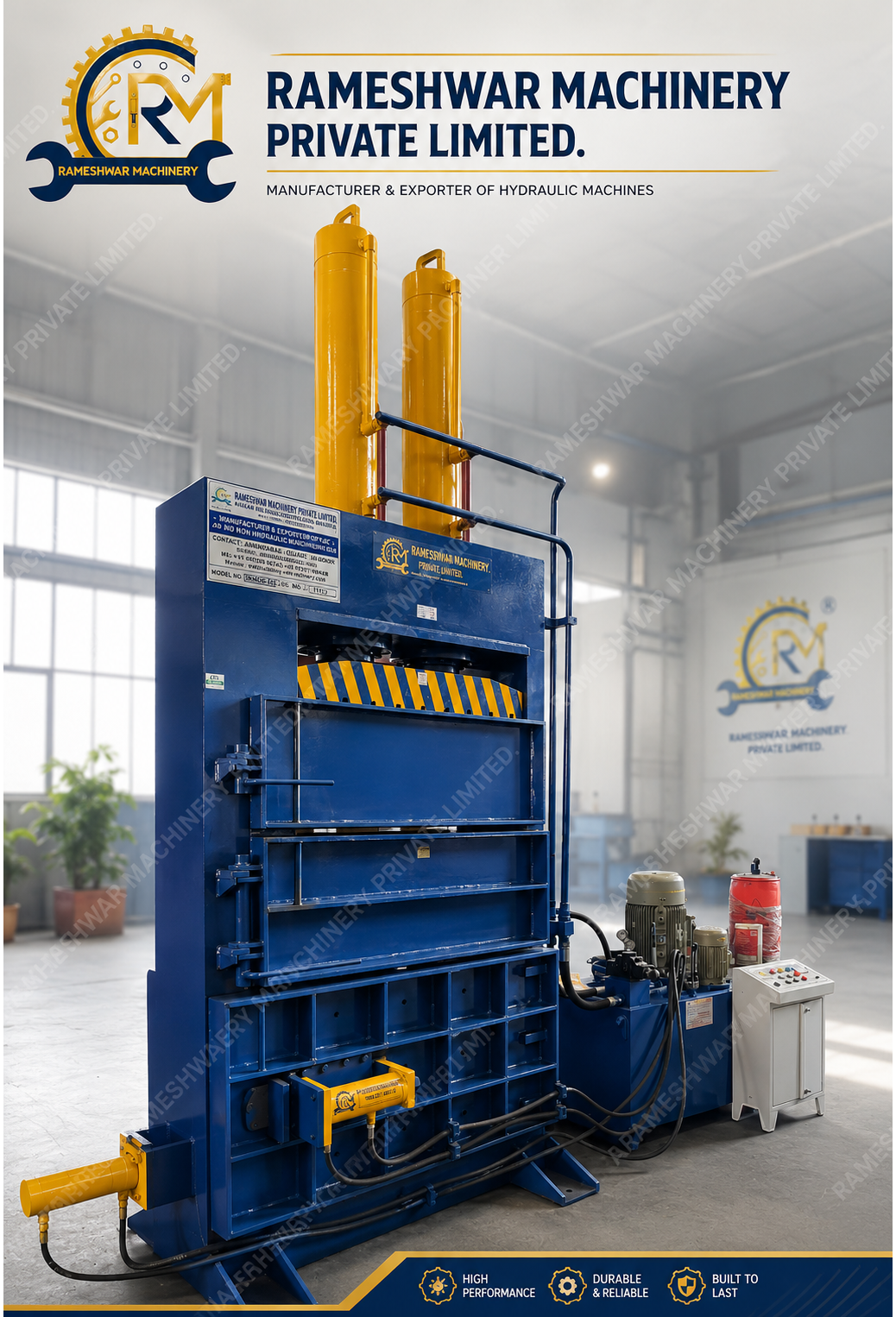
A 150-ton label tells you the nominal pressing force, not the bale weight, density, production rate, or suitability for your cotton feed. By comparing the chamber, bale specification, tie system, measured throughput, installation demands, and service obligations, you can turn supplier claims into a defensible purchase decision.
Key takeaways
- Confirm whether 150 tons means metric tonne-force, short-ton force, or working force.
- Specify chamber dimensions, bale weight, bale density and cotton moisture range.
- Measure loading, pressing, tying, ejecting and resetting in the complete cycle.
- Make the supplier prove output, bale quality and service response during a witnessed trial.
What does “150 tons” actually tell an Ahmedabad processor?
A 150 ton cotton baling press is rated for nominal hydraulic pressing force, not a 150-ton bale, finished-bale density, or hourly output. Ask whether “tons” means metric tonne-force, US short-ton force, maximum force, or rated working force; these definitions are not interchangeable.
Verify the claim with F = P × A. A 150-metric-ton force at 250 bar requires about 0.0589 square metres of effective piston area, equivalent to one piston roughly 274 mm in diameter before friction and pressure losses.
1. Request the design pressure, test pressure, cylinder diameter, number of cylinders, usable stroke, cylinder mounting details, relief-valve setting, and written definition of the quoted force. A maximum-force figure can overstate the force intended for continuous operation.
2. Inspect frame section details, weld design, platen parallelism tolerance, guides, and evidence of repeated-load endurance. A strong label cannot compensate for platen tilt, guide wear, poor cylinder support, or a frame that fatigues under daily cycles.
3. Compare cotton presses with cotton requirements, not scrap-metal balers. Scrap machines use different feed geometry, resistance, shear action, and density targets; their excessive force can damage fibre, waste energy, or produce unacceptable bales.
4. Compare chamber dimensions, bale-length control, pre-compression, tie access, and cycle time alongside force. A supplier must state whether each rating is maximum or working force and provide test records for density, bale shape, and tie retention.
Match the chamber and bale specification to the cotton you actually receive
A cotton baling press machine in ahmedabad suits your line only if its chamber matches the material entering it. Record moisture, fibre length, loose bulk, dust, foreign material, and the preparation step for loose cotton, opened fibre, lint, cotton waste, or contaminated feed.
| Feed | Main risk | Check before selection |
|---|---|---|
| Loose cotton or opened fibre | Uneven filling and spring-back | Loading method, bulk density, pre-compression |
| Lint or cotton waste | Dust, static, fibre breakage | Moisture range and feed preparation |
| Wet cotton | Inflated gross mass and storage deterioration | Sampling location, test method, allowable moisture |
| Contaminated cotton | Product rejection and chamber fouling | Foreign-material limits and cleaning access |
Specify press-box internal length, width, height, usable volume, piston travel, and finished bale dimensions. A stated 400-litre chamber does not equal a 400-litre cotton charge or a guaranteed bale weight: loose bulk density, feed distribution, pre-compression, and the closing point determine measured input mass.
Demand a witnessed weigh-in; do not let litres become an invented bale weight.
Write the acceptance specification for target density, target mass, gross or net weight, dimensional and mass variation, squareness, and recovery after ejection. Excessively dry cotton raises dust, static, and fibre breakage.
Confirm the number and placement of steel ties, wires, or synthetic straps, plus manual, semi-automatic, or integrated tying. Coir, FIBC, woven-sack, and scrap presses are poor substitutes when chamber geometry, contamination control, feed behaviour, or tie access differs.
Measure production by the complete cycle, not the hydraulic stroke
A useful output figure comes from the complete bale cycle, not the hydraulic stroke. Inspect and prepare the feed, load the chamber evenly, pre-compress, apply the main pressing stroke, install and tension ties or straps, release pressure, eject the bale, then unload it for weighing and inspection.
| Cycle stage | Record separately | Failure if ignored |
|---|---|---|
| Loading | Feed preparation and loading time | Hourly output is overstated |
| Pre-compression | Pre-compression time | Loose edges and uneven density |
| Main pressing | Pressing time and oil temperature | Laboratory figures do not hold |
| Tying | Tie or strap installation time | Manual work becomes the bottleneck |
| Ejection and handling | Release, ejection, unloading, weighing, and inspection time | Claimed cycle omits real labour |
A quoted cycle time is unusable without the bale size, cotton condition, loading method, oil temperature, operator count, and confirmation that tying and ejection are included. Record completed cycles per hour during a normal shift; do not multiply catalogue stroke time by an assumed workday.
Test uneven loading deliberately. One-sided feed produces wedge-shaped bales, uneven tie tension, platen misalignment, and guide wear.
Close these technical gaps before comparing offers:
- Motor rating, supply voltage and frequency, pump type, displacement, rated flow, operating pressure, reservoir size, filtration, cooler capacity, expected energy use, and duty cycle.
- Floor loading, foundation, delivery access, dust removal, ventilation, monsoon moisture control, and utility reliability at the Ahmedabad site.
Use a witnessed trial to turn claims into acceptance criteria
A witnessed trial turns a 150-ton claim into measurable acceptance criteria. Use the processor’s own cotton, not uniform factory feed, and agree the pass limits before testing.
| Measure | Trial record | Acceptance criterion |
|---|---|---|
| Bale output | Mass, all three dimensions, density = mass ÷ finished volume | Agreed mass, dimensional tolerance, density range and squareness |
| Material quality | Moisture method and sampling location; visible fibre damage | Agreed moisture range and no unacceptable damage |
| Retention | Tie or strap tension and retention after ejection and handling | No loosened ties or opened bales |
| Production | Every cycle element, rejected-bale rate and operator count | Maximum cycle time, rejection rate and labour agreed in writing |
| Machine condition | Oil temperature and electrical consumption | Oil stays below the agreed limit; energy use fits the site |
Weigh the cotton entering each cycle and the finished bale leaving it. Time loading, pre-compression, pressing, tying, pressure release, ejection and handling separately, then record spring-back after ejection.
Run loose fibre, lint, waste cotton, contamination, moisture and feed preparation across their normal ranges. A demonstration using pre-conditioned cotton proves little if ordinary material causes wedge-shaped bales, excess dust or frequent rejection.
A 150-ton press is the wrong choice when throughput is low, floor area or electrical supply is limited, feed preparation is unsuitable, tying consumes excessive labour, or a smaller machine already meets the buyer’s specification. Compare total handling effort, not force alone.
Have both parties sign results that identify quoted specifications, witnessed trial results and service promises separately. That prevents a sales claim from becoming an untestable acceptance condition.
Compare the supplier’s installed solution and lifetime support
A lower quoted price can disappear through freight, foundation work, electrical installation, labour, tie or strap consumption, oil, filters, spare seals, service travel and breakdown downtime.
Put machine price, commissioning, planned maintenance, training, warranty exclusions, response time, resale value and future expansion into one worksheet before comparing a cotton baler manufacturer in Gujarat with an outside supplier.
| Supplier option | Compare in writing | Evidence to demand |
|---|---|---|
| Installed local solution | Freight, civil work, electrical installation, commissioning, labour and service travel | Scope, exclusions and response-time commitment |
| Remote or imported solution | Spare seals, valves, pumps, sensors, tie tools and hoses; breakdown downtime | Local stock list, trained personnel and parts lead times |
| Any quoted model | Price, warranty, maintenance, resale and expansion capacity | Signed commercial offer and acceptance-test terms |
Request these documents before signing:
- General arrangement drawing, press-box dimensions, hydraulic schematic, electrical drawings, motor and pump ratings, pressure settings, parts list, manuals and risk controls.
- Written trial terms covering bale mass, dimensions, density, moisture, tie retention, cycle time, oil temperature, electrical consumption, recovery after ejection and visible fibre damage using your own cotton.
- Commissioning record, training scope, warranty exclusions and the names of stocked seals, hoses, valves, pumps and sensors.
On delivery, inspect the frame for transport damage, platen alignment, guards, emergency stop, interlocks, hose routing, fittings, leaks, fasteners, enclosure, oil cleanliness and accessible service points. Ask for inspection intervals for oil, filters, hoses, seals, guides, alignment and fasteners.
Rameshwar Machinery Private Limited belongs in the same documented comparison when it quotes the model; location or the phrase cotton baling press machine in Ahmedabad is not evidence of support.
Related product
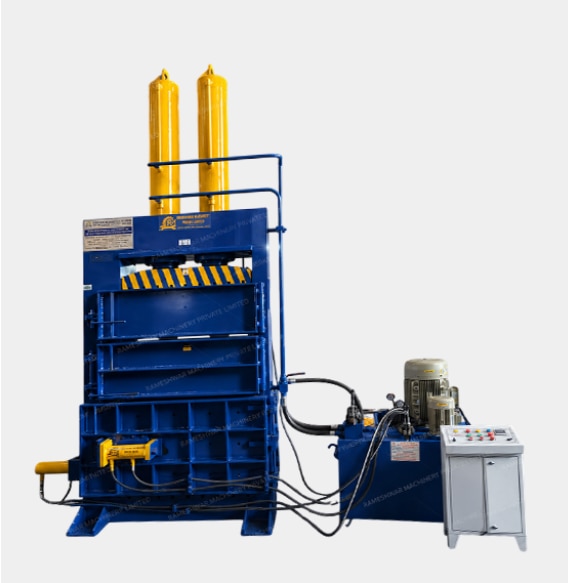 | Cotton Baling Press from Rameshwar Machinery is listed with reference specifications and product imagery sourced from the manufacturer catalog. View product → |
Frequently asked questions
What does a 150-ton rating tell an Ahmedabad cotton processor?
It states nominal hydraulic pressing force, not bale weight, finished-bale density or hourly output. Confirm the force unit and whether it is maximum or rated working force.
How should you match a cotton baling press to incoming cotton?
Compare the chamber dimensions and bale specification with your actual cotton type, moisture range, bale weight, density target and tying method.
Why measure the complete baling cycle instead of the hydraulic stroke?
Hourly output includes loading, pressing, tying, bale ejection, resetting and interruptions. A fast hydraulic stroke alone does not establish production capacity.
What should a witnessed trial prove before purchase?
The trial should record bale weight, dimensions, density, cycle time, bale integrity, operator steps and output using your own cotton.
How should you compare cotton baler manufacturers in Gujarat?
Compare the installed machine, commissioning, operator training, spare-parts access, maintenance response and documented acceptance criteria—not only the press rating.
Keywords